“The Life We’re Looking For” by Andy Crouch Reviewed by Angie Paulson
Main Point
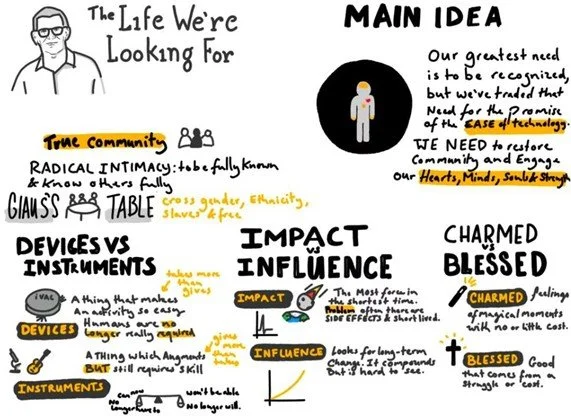
In The Life We’re Looking For, Andy Crouch’s main point is that we’re increasingly trading real relationships with each other and God for the magic of technology. This isn’t completely new; however, recent changes in the world from the industrial, financial and telecommunication revolutions have made this view dominant in society.
Andy contends that to be truly satisfied, we need to promote a society where we are fully human and in true relationships with God and each other. This means we recognize each other as beings of immense worth, no matter our differences, and engage our:
· Hearts
· Souls
· Minds
· Strengths
The Search for True Relationships and a Lesson from Gaius’s Table
To give an example of true relationship, Andy highlights the community in the background of Paul’s letter to the Romans.
This group of slaves and free people, men and women, Jews and Gentiles met in the house of Gaius, a wealthy Roman head of household. Here, although they were treated very differently by society, they were all equal.
One of the shocking details Andy shares is the person who writes Paul’s letter, Tertius, is a slave named Third. By society, he was viewed of so little importance that he was merely denoted by the order of his birth. And yet Paul invited Tertius to add his name to the letter, showing him equally as import as Gaius.
This kind of relationship, where we see and value even the people neglected by society, is what Andy argues for pursuing.
Devices vs. Instruments
A core point Andy distinguishes is between devices and instruments.
A device is something with makes an activity so easy that humans are no longer really required. An example is how a Roomba can tidy up the house with no human effort.
This seems like it’s an unqualified good; we no longer must do a boring, time-consuming or difficult task. However, there are usually unforeseen consequences of devices.
We usually adapt for our devices. Using the Roomba example, we might design our homes, so they are more suitable for our robot friends to clean. Similarly, unlimited access to the internet can lead us to watch endless entertainment rather than engaging deeply with what we watch.
Instruments, on the other hand, still augment our skills or abilities but require skill (and usually focus) to use. For example, a bike allows a person to travel further than by foot but still engages the senses and requires strength. Going for a bike ride might leave you tired but often comes with a sense of achievement. Compare that to the experience of a long-haul flight; you can travel further than ever possible in a short time, but you passively sit the whole time.
Does it give more than it takes?
A key question to our evaluation of the tools around us is if they give more than they take.
An instrument will allow us to do new things without imposing new requirements or constraints upon the user. A great instrument also empowers us to more fully use our hearts, souls, minds and strength and
deepen relationships. In contrast, a device will impose more limits than benefits and reduce us as humans.
Impact vs. Influence
Personal note: Using impact as a verb is one of my pet peeves and has been for a while. So, I was delighted to see Andy has similar issues with it the word.
He points out the recent usage of the word, and how there are many other options including
influence. I’d go further and say that every other near synonym is more expressive than impact. Andy does, however, point out why impact has become a popular verb: it reflects quick, significant change.
In our current society, the goal of moving fast and breaking barriers is lauded. Caution is negative, so any negative side effects are seen as costs of innovation.
But impact is short lived, and so another impact is required. And then another and another. All the while the shockwaves of these impacts can be causing colossal damage. Just look at the data around self-esteem and use of Instagram while marketing experts make the algorithms more addictive.
The alternative is influence, which looks at long-term change and compounding effects. It’s not about making massive changes now, but about deliberate movement towards a goal.
Influence isn’t as popular and can often be missed in the moment. Contrast that with impact with easy to see results. In the long run, impact leads to burnout and influence leads to growth.
Charmed vs. Blessed
A final key difference is between charmed and blessed.
Andy highlights how many of the examples we might tag on social media as #blessed are really examples of living a charmed existence.
A charmed existence is one free of worry, pain and work.
An all-inclusive holiday in the sun where we don’t lift a finger and all our needs are catered to instantly. Sounds wonderful, but there are negatives.
Charm is costly, not just financially, but costly in terms of personhood. To keep a charmed lifestyle for some, others must live in servitude. Yes, tourism can help raise economic standards in some places (while making them dependent) but costs still need to stay low to keep servitude possible. Furthermore, the relationship between the charmed person and the server isn’t one of equals. It’s one of subjugation via economics.
The contrast is a blessed existence, one which is rich in love but is costly, too.
Andy draws examples of Biblical figures such as Abraham, Jacob and Jospeh who are blessed but after suffering or through suffering. He even draws on his own story of his friend dying of cancer. Despite being immensely painful, blessing came from being able to be so close with him in the suffering.
Highly recommend! Pick up your copy of The Life We’re Looking For today.